










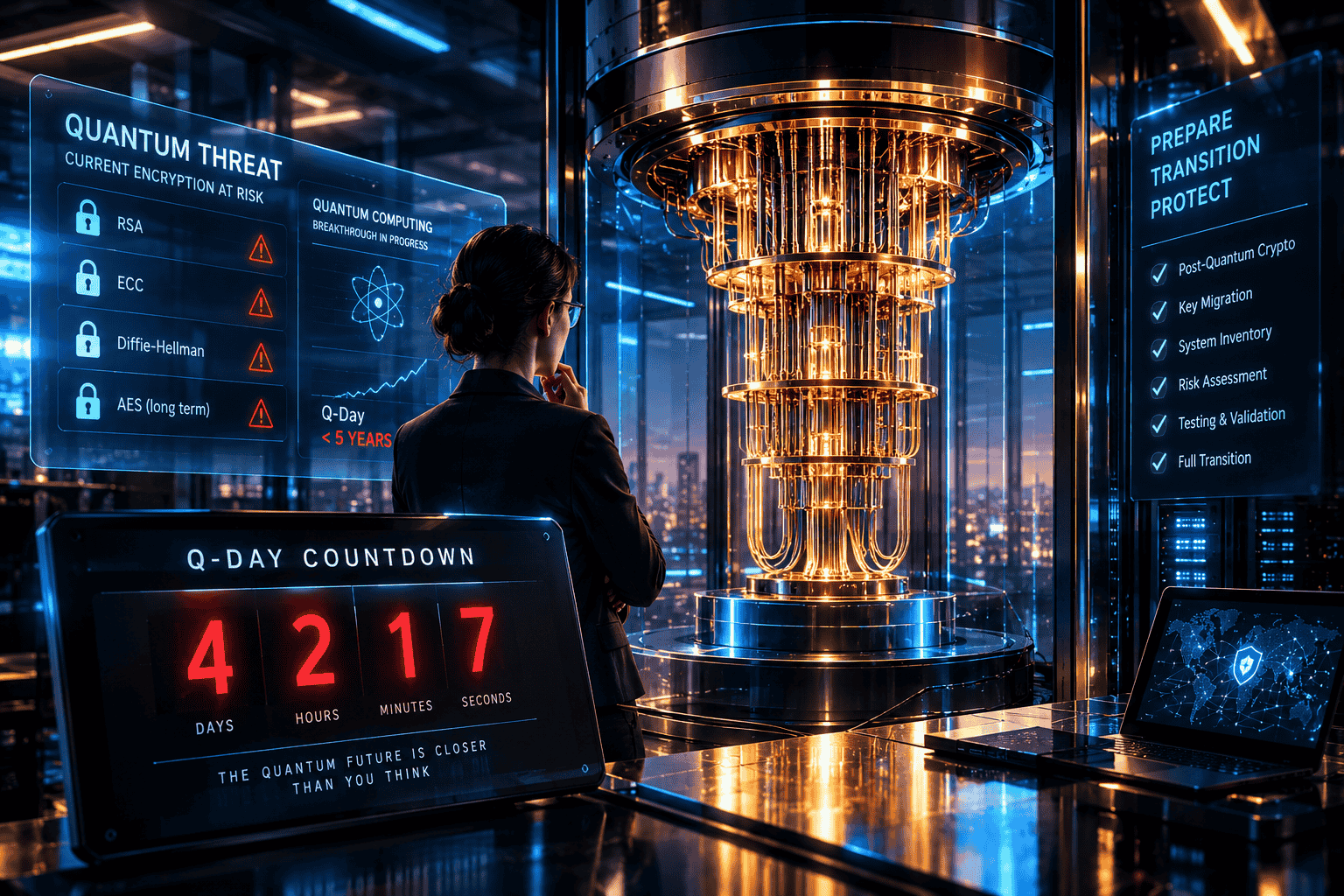
Welcome to Smart Code News. This month, we are talking about a deadline. For the better part of a decade, "Q-Day", the moment a quantum computer breaks the cryptography securing the internet, has been a hypothetical. A concern for cryptographers and standards bodies, but not yet a line item on an engineering roadmap. As of February 2026, that changes.
We have officially moved past the theory phase. NIST has finalized its first three post-quantum cryptography standards (FIPS 203, 204, and 205), replacing the RSA and ECC algorithms that have underpinned digital trust for decades. Regulators are responding with hard deadlines, and major hyperscalers like Cloudflare and Microsoft are now treating PQC as the new security baseline for the web.
For the API ecosystem, this is not just a compliance update. It is a migration of the foundational layer upon which every authenticated request, every signed payload, and every secure channel is built. It is a transition that requires us to rethink the lifecycle of our integrations, from the handshake to the deprecation notice.
This month, we explore the path to PQC readiness for API designers and platform engineers. We will unpack what the new NIST standards actually mandate, why "harvest now, decrypt later" is a present-tense threat, and how to begin inventorying and upgrading the cryptographic contracts your APIs depend on. In an era where trust must outlast the hardware that secures it, the only wrong move is waiting for Q-Day to arrive before we act.
The Math Problem at the End of Trust
To understand why our current security is failing, we have to understand the math that secures your API calls today. When your service establishes a TLS handshake or signs a JWT with RS256, it is leaning on a simple bet: that factoring large prime numbers, or reversing certain elliptic curve operations, takes classical computers millions of years to solve. It is a trap door function, easy to go through one way, impossibly hard to reverse.
Unlike classical bits, which are either 0 or 1, quantum bits (qubits) leverage superposition and entanglement to explore many possibilities simultaneously. Algorithms like Shor's Algorithm, designed for a sufficiently powerful quantum computer, can factor those large primes and reverse those elliptic curves in hours instead of epochs. The trap door swings both ways.
This is not an abstract physics experiment. The mathematics underpinning RSA and ECC, the very algorithms that authenticate your servers, encrypt your payloads, and sign your webhooks, are mathematically vulnerable to this approach. When a machine reaches the required scale, the algorithms break completely. Not "we need longer keys." Broken.
The Path Through The Migration
The migration to post-quantum cryptography is not a flag we flip. It is a systematic replacement of the cryptographic primitives that have defined internet security for decades. The path forward, as defined by NIST's finalized standards, is a transition to new mathematical problems, ones that quantum computers cannot shortcut.
The first three standards tell the story. FIPS 203 (ML-KEM) is our new foundation for key exchange, replacing the Diffie-Hellman and ECDHE handshakes that establish every TLS session today. FIPS 204 (ML-DSA) becomes the workhorse for general-purpose digital signatures, the successor to RSA and ECDSA that will sign your code, your certificates, and your assertions. FIPS 205 (SLH-DSA) provides a backup, a hash-based signature scheme that rests on different mathematical assumptions, ensuring diversity in our defenses.
For API engineers, this translates to a timeline with three distinct horizons.
The near-term horizon (2026–2028) is defined by experimentation and hybrid interoperability. Cloudflare, Google, and Microsoft have already spent years testing dual-protocol handshakes. Your focus here is enabling hybrid modes where your infrastructure allows it, not as a permanent state, but as a proving ground for the new algorithms in production traffic.
The mid-term horizon (2028–2032) is when the ecosystem hardens. Certificate authorities will begin issuing PQC chains by default. Client libraries and SDKs will deprecate classical-only modes. This is the period where the cryptographic contracts your APIs depend on shift beneath you, and the cost of inaction compounds.
The long-term horizon (2033–2035) is the hard cutover. By CISA's target and the industry momentum building behind it, the classical algorithms must be disabled entirely. The hybrid training wheels come off. At that point, your API contracts either speak the new language, or they are silent.
The Three Pillars of PQC Readiness
The transition to post-quantum cryptography is not a single upgrade but a layered migration across your entire API stack. To navigate this without introducing fragility or breaking existing integrations, engineering teams must adopt a structured approach that addresses the handshake, the payload, and the chain of trust. Here are the foundational disciplines to embed now:
Hybrid Cryptography → Handshake Without Lockout
The immediate risk is not the quantum computer that exists, but the client that does not yet support PQC. Deploy hybrid modes (classic + PQC) in your TLS termination points and certificate authorities. This ensures modern clients benefit from quantum-resistant key exchange while legacy clients continue to function. It is a compatibility bridge that buys you time to inventory dependencies without breaking production traffic.
Cryptographic Agility → Algorithm as a Movable Part
Your code must stop assuming algorithms are permanent. Abstract cryptographic primitives behind interfaces that allow rotation without rewrites. Your JWT signing, your mTLS configuration, your webhook signatures, each should reference a configurable provider, not a hardcoded RSA or ECDSA call. When the mandate comes to disable a vulnerable algorithm, you want to change a configuration, not redeploy a service.
Dependency Auditing → The Supply Chain Question
Your own code may be ready, but your dependencies are the long tail. Every third-party library, every cloud SDK, every identity provider you integrate with will have its own PQC migration timeline. Establish a formal inventory of where cryptography lives in your stack and track each dependency's published roadmap. The weakest link in your chain of trust is the one you forgot you were calling.
When these pillars are integrated into your platform strategy, PQC migration shifts from a regulatory scramble to a managed, predictable lifecycle event. You stop waiting for Q-Day to force your hand and start controlling the timeline on your terms.
This is the new baseline for trust: systems built not just to withstand the threats of today, but to remain verifiable in a future where the math has changed.